Wednesday, September 15, 2010

Controlling the Cloud

Mobile LiDAR data on it's own is not what I would classify as "survey accurate" - being accurate enough to defend (sign and seal) for engineering design or similar services.  The same can be said for any survey instrument because the result depends entirely on the standard of care applied during collection and subsequent processing.  I'm going to provide the 10,000 foot perspective on how we achieve survey accuracies of Mobile LiDAR derived products.

First, let's revisit the blog on Project Planning.  In that posting, I discuss how the GPS solutions we achieve differs throughout the day due to the constant motion of the constellation.  Therefore, if we were to drive the same area twice, we would very likely get different results.  We utilize a process much like Aerotriangulation in Photogrammetry with respect to our individual strips.  The process employs ground control points (measured to a higher level of accuracy or certainty) to tie overlapping strips together.

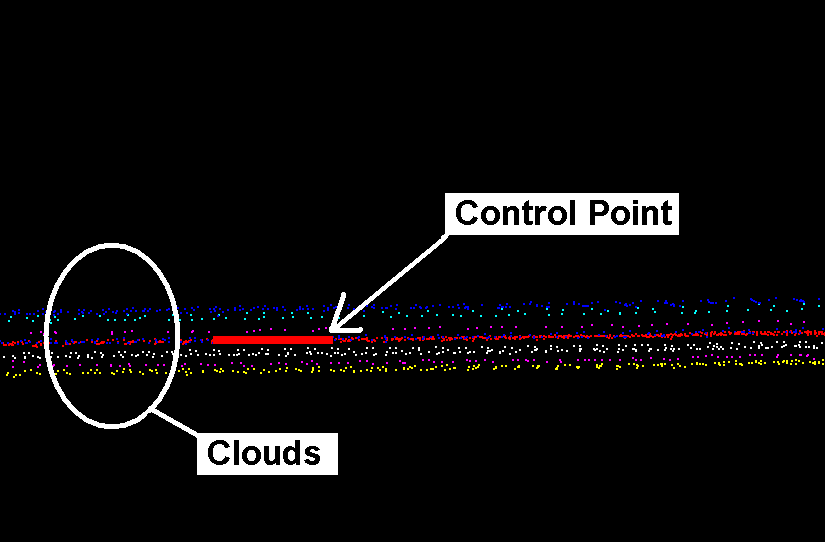
In the image below, we've color coded the different strips and are depicting the Z/Elevation axis.  The eight strips present a "thickness" both above and below the respective control point.  In this example, the variance between high and low is about 0.25' - or 0.13' above and 0.13' below the control point.

Using tie-lines, our processing staff links the point cloud to the ground control.  The process can also be applied between an adjusted and unadjusted point cloud using "LiDAR identifiable" points (similar to a cloud to cloud registration applied in static scanning).  Below is a screen capture following adjustment. The variance in the cloud is approximately 0.02' - resulting in a highly effective adjustment and providing the foundation for deriving final products.


No matter what we would like to believe, surveying is not absolute.  There are errors, whether systematic or random, in each measurement.  Where the differentiation lies, is in the ability to minimize or effectively eliminate those errors through field collection best practices, processing algorithms and a general appreciation of the work being performed. 

Monday, September 13, 2010

The Year in Review

It's hard to believe, but yesterday marks the 1st Anniversary of the installation of Baker's LYNX Mobile LiDAR system in Beaver, PA.  Following the build out of the storage drawers and vehicle wrap, we spent the day installing and calibrating the system in addition to running inside to catch up on college football scores. (Revisit our first blog - Day 1: System Install)


Inside the Numbers:
Over the past year, Baker staff have exhibited or presented at a dozen national conferences, more than 30 regional conferences and countless Baker offices, local meetings and user groups.  We have written more than 30 blogs which has attracted over 3,000 visitors and nearly 10,000 page views. Our staff continues to add content and videos on an increasing array of topics.

The Mobile LiDAR unit has performed collections from Pennsylvania on south to Florida; we've collected the Atlantic Ocean in Virgina to the Pacific Ocean in California.  Our collection crew has put more than 30,000 miles on the vehicle and collected about 50 terabytes of data.

Yes, I'm reading instructions - contrary to every other time in history.
We've performed collections along levees, neighborhoods, highways, runways, railways, rivers and beaches. During all of this, I have been the only person who has managed to get the vehicle stuck - once.  And a few months ago, we added the auxiliary vehicle to our fleet increasing our capabilities.

Our Mobile LiDAR team continues to race forward and push the technology.  It is exciting to be a part of the team and work with such dedicated professionals. I'm certainly looking forward to year 2 and what it has in store for us.

Thank you to all that have made this possible.

Wednesday, August 25, 2010

Baker at AREMA

Michael Baker Jr., Inc. will be exhibiting at the upcoming 2010 Annual Conference of the American Railway Engineering and Maintenance-of-way Association (AREMA).  The conference is being held at Hilton Orlando from August 29th through September 1st.  Look for Baker representatives at Booth #616.  


Monday, August 23, 2010

Upcoming Workshop

On Wednesday, August 25th, Stephen Clancy will be presenting a 3 hour workshop titled "Mobile LiDAR: An Overview of Surveying's New Tool" at the 55th Annual FSMS Conference in Naples, FL.


Stephen will present Mobile LiDAR basic concepts, collection, preliminary processing and final deliverables. 


Portions of the course will be made available through the blog beginning the first week in September.  


Tuesday, August 17, 2010

Project Planning - GPS

Expanding upon an earlier post - Measuring Systems Part 1 - Positioning, I would like to talk about planning. Perhaps the most significant factor in a successful collection is the GPS constellation.  Since the vehicle encounters many obstructions to the sky - trees, buildings, signs and other structures to name a few - it is desirous to collect when there is the highest likelihood of satellite visibility.  Sometimes this means our Mobile LiDAR crew is collecting in the early morning hours.

Utilizing simple planning software and an updated GPS almanac, we're able to input our project latitude and longitude coordinates to determine the times that we should be collecting - and when the crew should be doing something else.


The image above shows a 24-hour period for New Orleans, LA.  The number of visible satellites is but one thing we look at.  In addition, we look at the Position Dilution of Precision (PDOP) - a measure of strength of the geometry of the satellites.  Typically, the number of satellites has a direct correlation to PDOP (take a look at the dip in satellites around 08:30 above with the spike at the same time below).  However,  it does not necessarily mean that you will have a high PDOP if you have fewer satellites if the geometry of those satellites is strong - evenly distributed in the sky.


The successful completion of any project is planning.  The planning we perform for our Mobile LiDAR collections occur at many levels, each of which can vastly influence the results.